


(Natural News)
The average person living today has little idea how far the development of self-assembling nanotech biocircuits has progressed. So-called “fact-checkers” (professional propagandists and liars) deliberately mislead people into thinking there’s no such thing as a self-assembling graphene-based biocircuitry system that could be feasibly injected into people and called a “vaccine,” but the published scientific literature lays out a comprehensive, well-documented body of research that shows this technology is quite real… and has been tested in biological systems for at least two decades.
A “self-assembling” system means that a person is injected with instructions that set into motion a process where a structure is assembled inside the body, using resources available in the blood (such as iron and oxygen atoms). In effect, nanotech self-assembly means that a microchip doesn’t need to be “injected” into someone, since the circuitry can be assembled in vivo after injection.
Every biological creature on Earth is a living example of self-assembly, by the way, since DNA is a self-assembled nanostructure. Genetic replication is, of course, a process rooted in self-assembly. So anyone who doesn’t realize self-assembly is a real phenomenon is rather ignorant, even about the mechanisms at work in their own body. Viral replication is also a self-assembly process, of course.
“A myriad of magnetic nanosystems can be created by using self-assembly as a synthetic tool,” says the abstract of a study published in January of this year. Published in the journal Aggregate Open Access, it’s entitled: Self-assembled magnetic nanomaterials: Versatile theranostics nanoplatforms for cancer.
The paper focuses on, “Self-assembled magnetic nanomaterials (MNMs)” and details their use in biomedicine, writing:
[M]agnetic fields have been widely used for nanomaterials assembled of one-dimensional (1D), two-dimensional (2D), and three-dimensional (3D) aggregates.
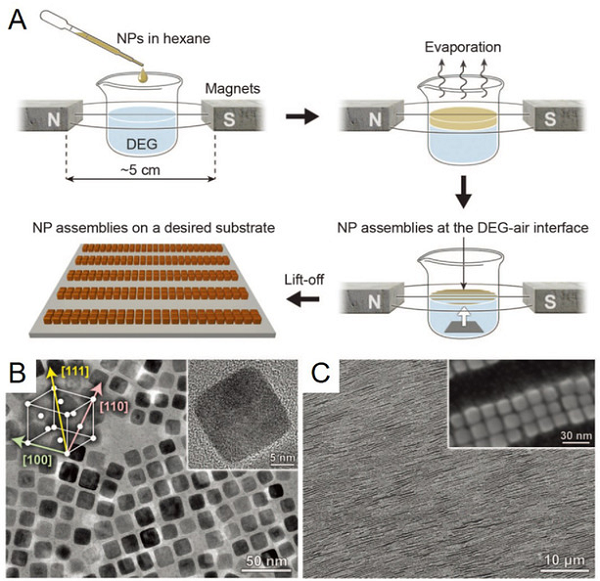
The study makes reference to the self-assembly of iron oxide nanoparticles, which can exhibit magnetic properties in certain configurations. These are known as SPIONs (Super Paramagnetic Iron Oxide Nanoparticles).
Author


Leave a Reply