


This is Part 2 of a series. See Part 1, published in 2005.
The US opioid crisis broadly defined bears a relationship to the export of heroin out of Afghanistan. How will this multibillion trade which until recently was protected by US forces be affected by the withdrawal of US troops from Afghanistan. Private mercenary companies are also involved in supporting the opium trade.
It should be understood that the US withdrawal has been the object of extensive negotiations between US-NATO and the Taliban. A deal was signed in Doha in late February 2020 at the outset of the Biden Administration.
Did the U.S. reach an agreement with the Taliban regarding the opium trade?
History
What is important to understand is that one of the key strategic objectives of the 2001 war on Afghanistan was to restore the opium trade following the Taliban government’s successful 2000-2001 drug eradication program which led to a 94% collapse in opium production, much to the detriment of the multibillion dollar narcotics trade. This program was supported by the United Nations. (For details, see below)
Restoration of the Drug Trade. Did the Invasion of Afghanistan Contribute to the Dramatic Increase in Heroin Addiction
In the course of the last decade, there has been a surge in Afghan opium production. In turn the number of heroin addicts in the US has increased dramatically. Is there a relationship?
There were 189,000 heroin users in the US in 2001, before the US-NATO invasion of Afghanistan.
By 2016 that number went up to 4,500,000 (2.5 million heroin addicts and 2 million casual users).
In 2020, at the height of the covid crisis, deaths from opioids and drug addiction increased threefold.
It’s Big Money for Big Pharma.
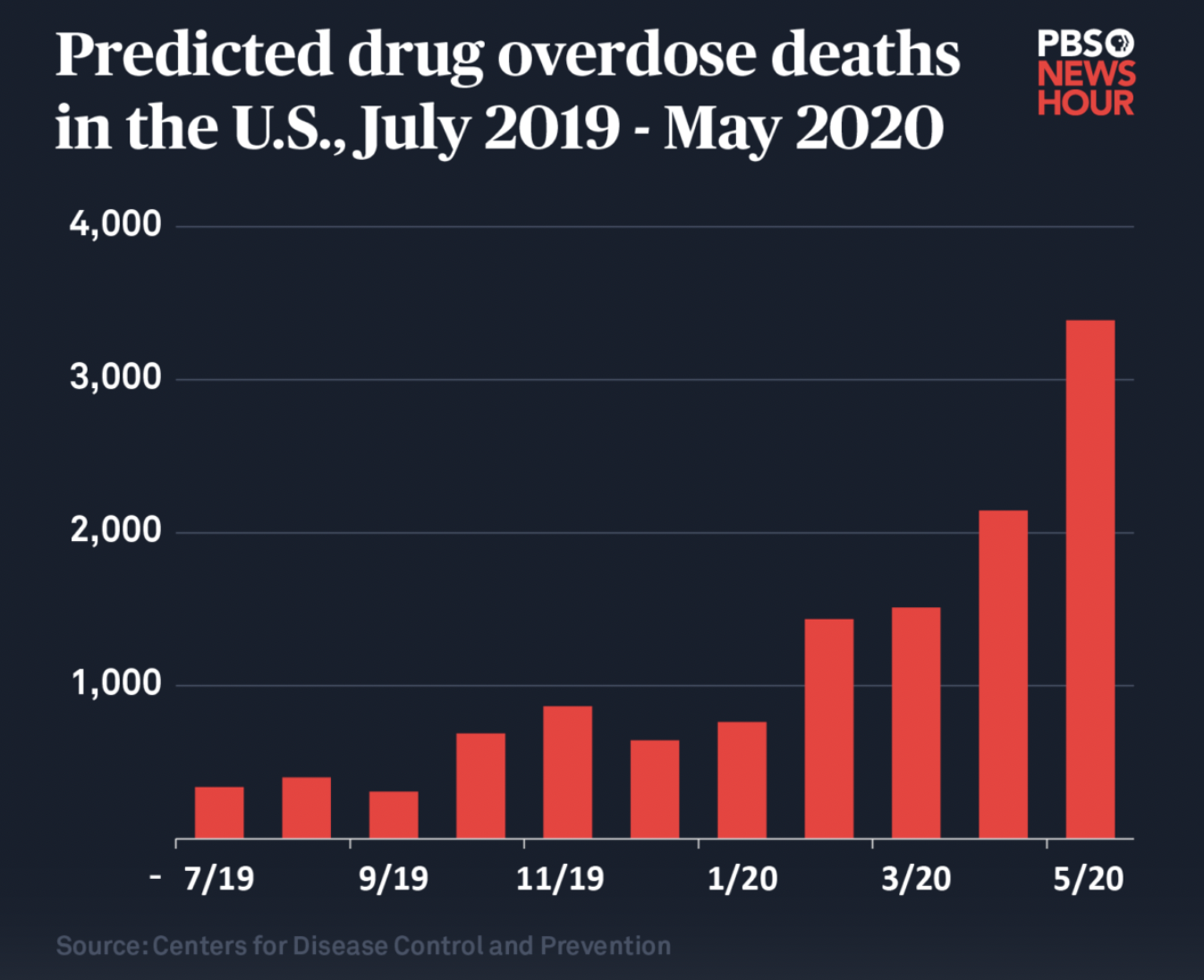
Graph based on CDC data Source PBS
In a bitter irony, Johnson and Johnson which is marketing its “experimental” COVID-19 adenovirus viral vector vaccine, just so happens to be a major producer of prescription opioids.
In November 2020 a “a tentative $26 billion settlement was reached with counties and cities across America which sued J and J and its distributors on behalf of opioid victims.
This class action law suit was “the largest federal court case in American history”. It coincided with the launching of the Covid vaccine initiative in early November 2020. (For further details see Michel Chossudovsky’s E-Book, Chapter VI).
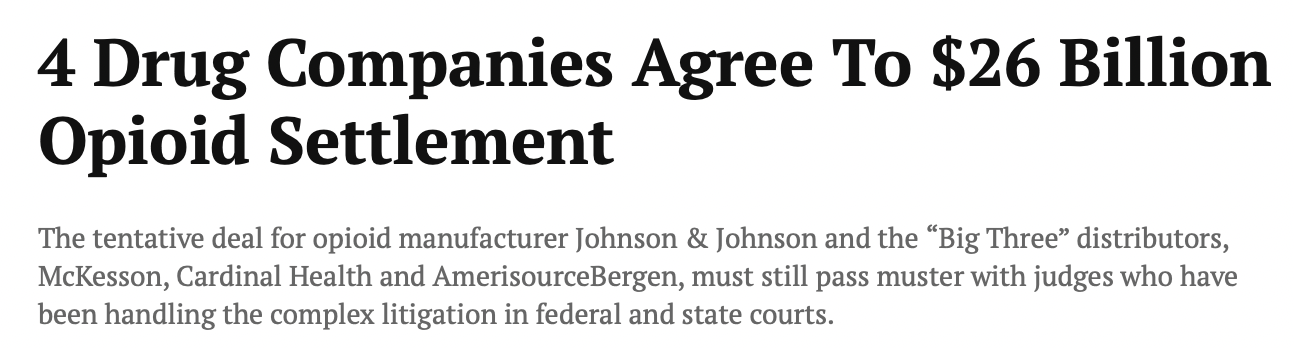
According to the Washington Post:
Johnson & Johnson and the “Big Three” distributors, McKesson, Cardinal Health and Amerisource Bergen, potentially brings a large measure of legal closure for the companies and will funnel money to communities devastated by an addiction crisis that claims more than 70,000 lives in America every year. (emphasis added)
Afghanistan currently produces 84 percent of the World’s opium which feeds the heroin and opioid markets.
Lest we forget, the surge in opium production occurred in the immediate wake of the US invasion in October 2001.
Who is protecting opium exports out of Afghanistan?
“In 2000-2001, the Taliban government –in collaboration with the United Nations– had imposed a successful ban on poppy cultivation. Opium production declined by more than 90 per cent in 2001. In fact the surge in opium cultivation production coincided with the onslaught of the US-led military operation and the downfall of the Taliban regime. From October through December 2001, farmers started to replant poppy on an extensive basis.” (quoted from article below)
The Vienna based UN Office on Drugs and Crime (UNODC) reveals that poppy cultivation in 2012 extended over an area of more than 54,000 hectares, an increase of 18% over 2011. A UNODC spokesperson confirmed in 2013 that opium production is heading towards record levels.
In 2014 the Afghan opium cultivation hit a record high, according to the United Nations Office on Drugs and Crime’s 2014 Afghan Opium Survey.( See graph below). A slight decline occurred in 2015-2016.

Source: United Nations Office on Drugs and Crime’s (UNODC)
According to the 2012 Afghanistan Opium Survey released in November 2012 by the Ministry of Counter Narcotics (MCN) and the United Nations Office on Drugs and Crime (UNODC). potential opium production in 2012 was of the order of 3,700 tons, a decline of 18 percent in relation to 2001, according to UNODC data.
There is reason to believe that this figure of 3700 tons is grossly underestimated. Moreover, it contradicts the UNOCD’s own predictions of record harvests over an extended area of cultivation.
While bad weather and damaged crops may have played a role as suggested by the UNODC, based on historical trends, the potential production for an area of cultivation of 154,000 hectares, should be well in excess of 6000 tons. With 80,000 hectares in cultivation in 2003, production was already of the order of 3600 tons.
It is worth noting that UNODC has modified the concepts and figures on opium sales and heroin production, as outlined by the European Monitoring Centre for Drugs and Drug Addiction (EMCDDA).
A change in UN methodology in 2010 resulted in a sharp downward revision of Afghan heroin production estimates for 2004 to 2011. UNODC used to estimate that the entire global opium crop was processed into heroin, and provided global heroin production estimates on that basis. Before 2010, a global conversion rate of about 10 kg of opium to 1 kg of heroin was used to estimate world heroin production (17). For instance, the estimated 4 620 tonnes of opium harvested worldwide in 2005 was thought to make it possible to manufacture 472 tonnes of heroin (UNODC, 2009a). However, UNODC now estimates that a large proportion of the Afghan opium harvest is not processed into heroin or morphine but remains ‘available on the drug market as opium’ (UNODC, 2010a). …EU drug markets report: a strategic analysis, EMCDDA, Lisbon, January 2013 emphasis added
There is no evidence that a large percentage of opium production is no longer processed into heroin as claimed by the UN. This revised UNODC methodology has served, –through the outright manipulation of statistical concepts– to artificially reduce the size of of the global trade in heroin.
According to the UNODC, quoted in the EMCDDA report:
“an estimated 3 400 tonnes of Afghan opium was not transformed into heroin or morphine in 2011. Compared with previous years, this is an exceptionally high proportion of the total crop, representing nearly 60 % of the Afghan opium harvest and close to 50 % of the global harvest in 2011.
What the UNODC, –whose mandate is to support the prevention of organized criminal activity– has done is to obfuscate the size and criminal nature of the Afghan drug trade, intimating –without evidence– that a large part of the opium is no longer channeled towards the illegal heroin market.
In 2012 according to the UNODC, farmgate prices for opium were of the order of 196 per kg.
Each kg. of opium produces 100 grams of pure heroin. The US retail prices for heroin (with a low level of purity) is, according to UNODC of the order of $172 a gram. The price per gram of pure heroin is substantially higher.
The profits are largely reaped at the level of the international wholesale and retail markets of heroin as well as in the process of money laundering in Western banking institutions.
The revenues derived from the global trade in heroin constitute a multibillion dollar bonanza for financial institutions and organized crime.
Record Production in 2016. Fake Eradication Program
“Opium production in Afghanistan rose by 43 per cent to 4,800 metric tons in 2016 compared with 2015 levels, according to the latest Afghanistan Opium Survey figures released today by the Afghan Ministry of Counter Narcotics and the UNODC. The area under opium poppy cultivation also increased to 201,000 hectares (ha) in 2016, a rise of 10 per cent compared with 183,000 ha in 2015.
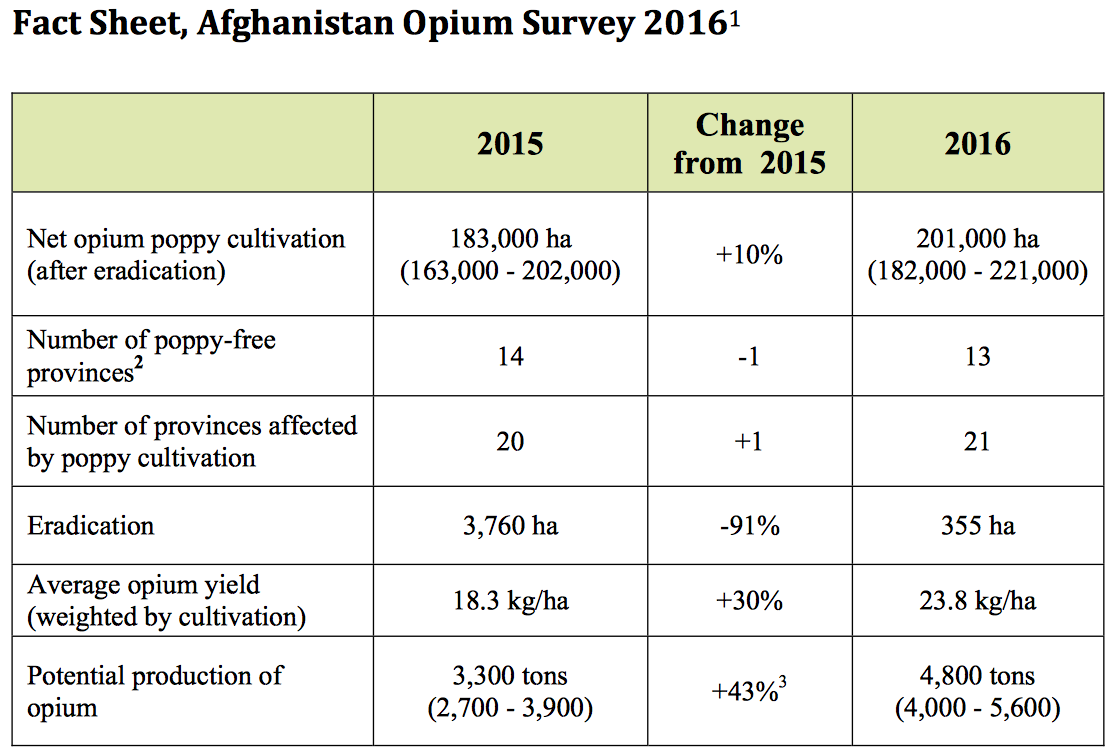
Source: UNODC
The following article first published in May 2005 provides a background on the history of the Afghan opium trade which until recently was protected by US-NATO occupation forces on behalf of powerful financial interests.
This post was originally published by Globalresearch.ca.
Author


Leave a Reply